
Spiritual · 7 minute read
The Power of Free Will
By Ray Coppola
The Power of Free Will
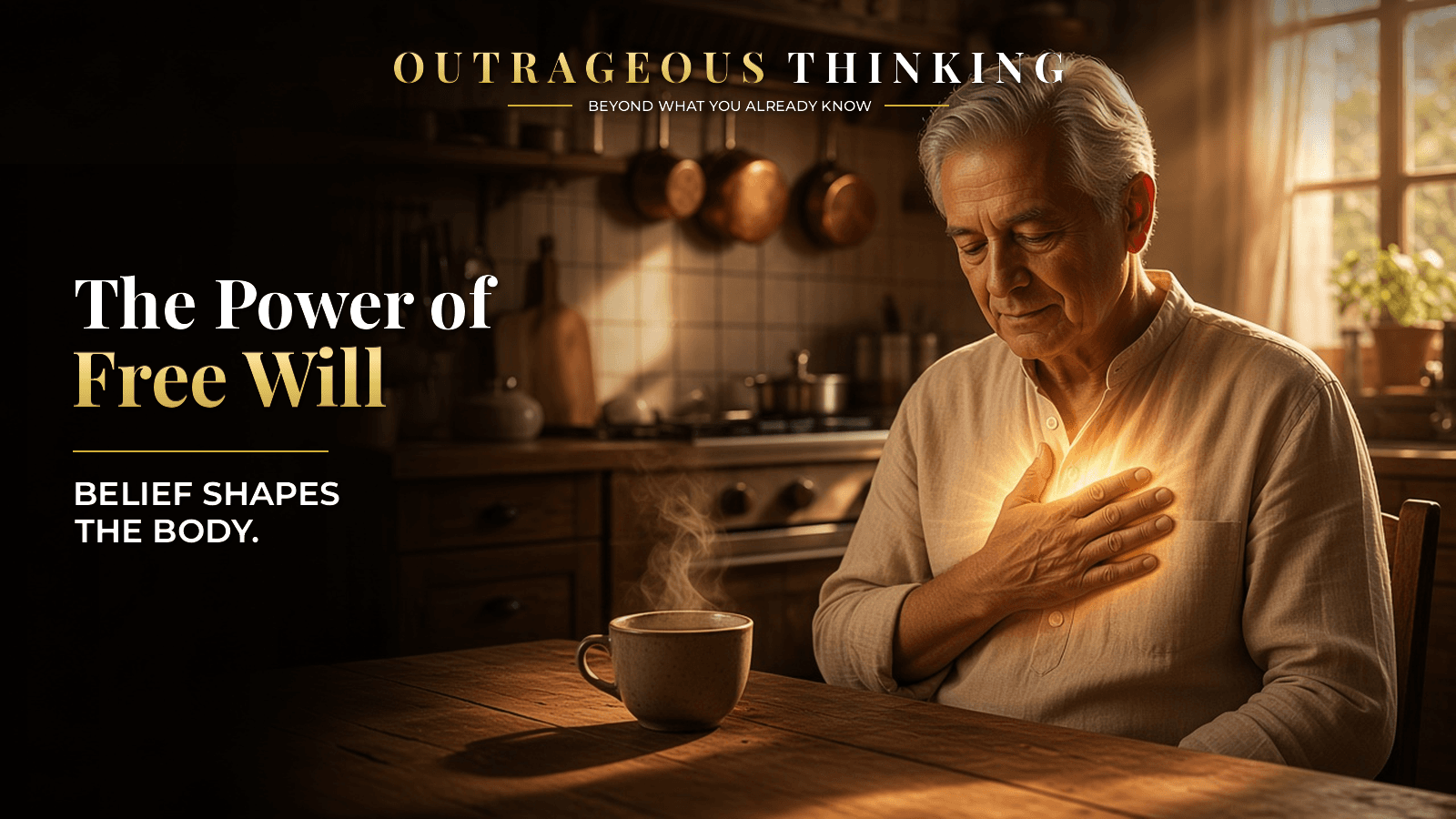
As Socrates said and Rankin quotes: There is no illness of the body apart from the mind. And this power of the mind and all our thoughts, feelings, and beliefs that we choose to have and uphold that Dr. Rankin speaks of, are all based on our free will decisions.
Here is the true astounding story of an entire town that lived in the Miracle Zone in the 1950's, the town of Roseto. Author Malcolm Gladwell tells this true story of the small town in his bestselling book, Outliers. This town of Roseto, in western Pennsylvania, was home to about 2,000 Italian immigrants during the late 1950's and 60's. Gladwell describes the investigations of Dr. Stewart Wolf who studied the health and longevity of life for the people of Roseto. While the rest of the country was prematurely dying of heart attacks at alarming epidemic rates, the vast majority of the people of Roseto were passing-on of old age.
As Gladwell describes, Wolf's findings were nothing less than astounding. Virtually no one under 55 had died of a heart attack or had any signs of heart disease; the death rate for those over 65 was half that of the rest of the country; the death rate from all causes was 35% lower than other Americans.
Moreover, the sociological aspects of Roseto mirrored Dr. Wolf's health findings in that there was no suicide; hardly any crime; no one was on welfare; and there were no alcoholics or drug addicts. His longitudinal study showed it wasn't their genes, it wasn't their environment and it wasn't their geographical location. Nor was it their physical exercise or eating habits, as many were obese. In every way but one the citizens of Roseto were like other Americans: they smoked; indulged in sweets; drank; many were overweight; did very little exercise; and they all ate lots of meat, lard, bread, pasta and desserts.
The only difference found in Roseto that made these people unique from the rest of the country were their social habits. For such a very small town of only 2,000 people, they had 22 civic organizations and most people belonged to a few of them. Many lived in three family homes consisting of grandparents, parents and their adult children. While the rest of America was creating a self-imposed, passive, and isolating condition for themselves, due to the dual inventions of TV and air conditioning, the people of Roseto were socializing with others as a constant in their lives. No one was isolated.
Another astounding story, regarding the power of our free will beliefs, concerns our pharmaceutical industry. Journalist Steve Silberman, in his article in Wired magazine titled, Placebos Are Getting More Effective. Drugmakers Are Desperate to Know Why, reports on how groups receiving the placebo sugar pill are often demonstrating better results than the groups that took the real drug.
He says: "Ironically, Big Pharma's attempt to dominate the central nervous system has ended up revealing how powerful the brain really is. The placebo response doesn't care if the catalyst for healing is a triumph of pharmacology, a compassionate therapist or a syringe of saltwater. All it requires is a reasonable expectation of getting better. That's potent medicine."
Whatever we believe (even if it is inherently wrong) is true for each of us. In one way or another, either subtly or overtly, our mind and our body will be influenced by the beliefs, attitudes, opinions and values we harbor within, and will, for better or worse, happen to and for us. There are no idle thoughts, there are no nebulous beliefs. There are no powerless free will decisions that we make. Our willful decisions and the thoughts and beliefs that generate those decisions are nuclear in their effects upon us. It doesn't matter if they be big or small, right or wrong, or if they are about ourselves, others, God or the world, sooner or later they will come true for us. This relates back to how our beliefs affect our physical and mental health.
This is the power that God gave to each of us in our creation. To make our own decisions and decide on our own beliefs. And even God cannot change our minds! If He did it would be the end of free will. And neither Jesus nor the Holy Spirit can change our minds, no more than our best friend or loving partner could change our minds if we don't want to change.
In a nutshell, the power of our free will beliefs is the truth that Dr. Rankin reveals to us in her book, Mind Over Medicine. Without saying it directly, this is the conclusion that any thoughtful reader of Steve Silberman's article in Wired Magazine must consider, and this is also what Gladwell points out so clearly in his study of Roseto.
To further this point, recent medical statistics and scientific studies are showing that the majority of people getting breast cancer today have no risk factors in their lives and never did. They didn't smoke, drink too much or overeat. They exercised, took vitamins, ate healthy foods, visited their doctors regularly, and had no history of cancer in their family. They were hardly ever around secondhand smoke, nor did they live in harmful environments either. And, of course, contrary to this, we are never told of all those who did smoke, overate, drank liquor regularly and then lived to a hearty, ripe old age.
So, what is left for any rational thinker? The recognition and acceptance of the power that our mindful beliefs, thoughts, and feelings, all of which we choose to have with our free will, have an overwhelming effect on and over us. That our bodies are reciprocators of our thoughts, feelings and beliefs. Our minds, which are filled with our thoughts, truly will lead our bodies to health and wellness, or illness and disease. Where else could all that stress and negativity go but into our bodies?
How do we harness the phenomenal power of our free will?
1. We become an objective observer of our thoughts with our own mind. Whenever we have a negative, fearful, angry thought or feeling we say to ourselves: No, I will not go there. I choose to have only joyful, loving happy thoughts. And then we forgive ourselves. 2. We engage in a process of training our mind through persistently practicing the above statement, not unlike we do when we decide to lose weight by persistently eating less and exercising; or getting a degree or license; or getting ahead at our job by choosing to put in the time and making the necessary effort to reach our goals. Harnessing the power of our free will is a skill that takes effort, practice, and mindfulness, like the other skills just mentioned. One must focus on it and mindfully practice controlling their free will to be able to use it to their benefit. This does not happen unconsciously or overnight; this is a mindful decision that requires practice and persistence to master. This might seem hard at first, but once practiced persistently your brain will automatically start to do it on its own, and you will be able to control your free will with increasing ease. Psychology defines this as neuroplasticity, in which the structure of our brain changes with every decision we make, thought we choose to engage in, and habit we practice. This makes anything new we try easier and easier the more we do it. 3. We pay attention to our thoughts and resist the tendency to let our minds wander aimlessly or worse, engaging in negative or fearful thoughts. 4. We keep in mind that we are doing this not only for our conscious mind, but also our unconscious mind, that it may release all it has stored within it that is negative or fearful. 5. We uphold in the highest regard the phenomenal power and God-like creative influence that our free will holds for us, for better or worse, depending on how we use it.
Continue the inquiry
What did this idea move in you?
Responses are read before they appear. Share honestly.